AI-Powered Drones: The Next Leap in Intelligent Flight
Drones have evolved far beyond remote-controlled flying devices. Aerial photography and surveillance were the initial uses of drones, but now they have become smart, autonomous, and self-governing systems that can decide on their own in a fraction of a second.
AI-powered systems can identify, interpret, and process environmental data with minimal human supervision. This shift is significant as industries demand faster data access, higher levels of accuracy, and safer ways to work in environments that are still changing rapidly.
Empowering Drones with Autonomous Intelligence
Artificial intelligence has fundamentally changed the whole concept of drones to the extent that they are now autonomous systems that can make real-time decisions without the need for human operators.
AI, thus enabling the drones to be fully autonomous, in a way, is the lifeline of the drones as it can keep them updated by processing data from onboard sensors, cameras, and navigation systems. It is also what keeps the drone alive and allows it to change its operation dynamically by adjusting the navigation path, detecting obstacles, and avoiding them. Additionally, it enables the drone to instantly react to and adapt to changing conditions.
Machine learning algorithms are built into drones, and they help drones recognize patterns and predict outcomes; hence, flight efficiency and safety keep getting better with time. Irrespective of whether they are flown in complex urban spaces or utilized in remote industrial environments, AI-driven autonomy is a guarantee of performance, which hardly needs intervention from a human.
The outcome is, therefore, quicker mission accomplishment, reduced operational risk in the exercise of operations, and elevated trustworthiness, which is why smart drones have become indispensable to the present-day, data-driven business landscape across different spheres of the economy.
Inside an AI Drone: What Happens Mid-Air?
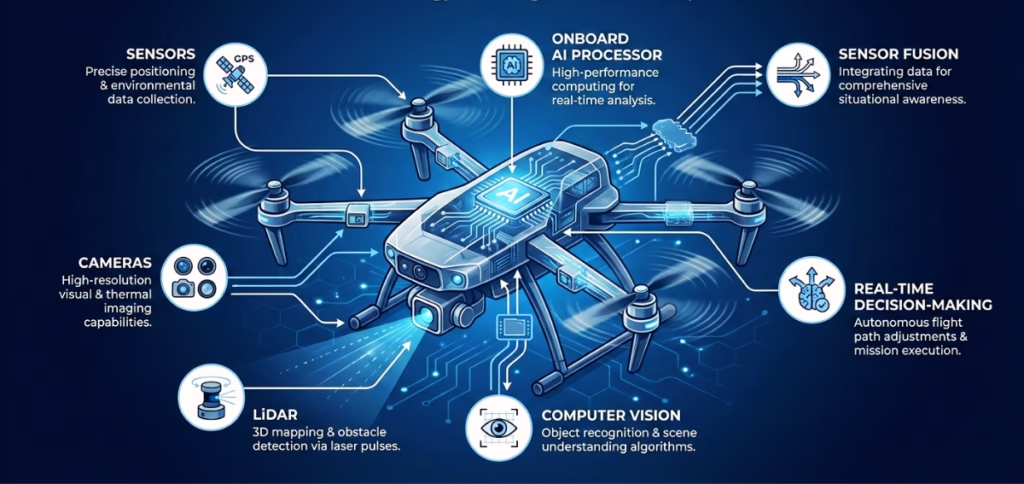
Once airborne, an AI-powered drone operates as an intelligent, self-directed system. Multiple technologies work together to enable real-time awareness and decision-making:
- Environmental sensing: The drone is equipped with several sensors, including cameras, GPS, IMU, LiDAR, and ultrasonic sensors. With their help, they can continuously monitor the position and movement of the drone as well as obstacles and the terrain around it.
- Onboard processing: The processors and AI accelerators that are installed in the drone locally handle the incoming data through the use of edge computing. This eliminates the time that would normally be taken to send the data for ground processing and then back to the drone.
- Computer vision: The AI-powered vision system consists of algorithms that understand pictures and videos to recognize objects, estimate distances, track motion, and even detect patterns or anomalies.
- Sensor fusion: The technology that combines data from different sensors can result in an incredibly accurate and up-to-date understanding of the environment the drone operates in.
- Instant decision-making: The drone takes the initiative to respond to the changing situation by altering its path, height, speed, and thus ensuring flight safety according to the data it has analyzed on its own.
With such close integration of sensing, processing, and perception, AI drones can carry out complicated tasks quickly, accurately, with great reliability, and minimal human control.
From Scenic Shots to Smart Missions: How AI Elevates Every Flight
Drones are no longer just scenic aerial capture tools. What used to be a creative branch of the business has now become task-oriented intelligent aerial systems.
With AI integration, drones today are able to perform extremely precise operations such as mapping, land surveying, infrastructure inspection, and monitoring in real-time. Besides the visual and sensor data, the flight algorithms are also analyzing the data on the spot to ensure accuracy to the last detail and that the outputs are trustworthy.
With the help of AI, drones can look for regularities, detect anomalies, and change their behavior according to the requirements of the mission without continuous human instruction. Hence, the change that has occurred is less manual work, higher efficiency, and faster getting of insightful data.
Therefore, drones have become indispensable instruments of the industries, the flights turning into smarter and more purposeful ones.
The Way They See the World: Vision Systems That Redefine Accuracy
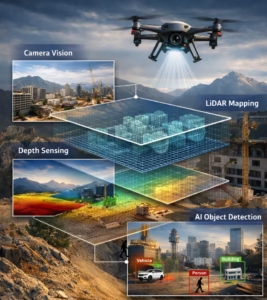
To understand the world with extraordinary accuracy, AI-driven drones employ cutting-edge vision systems. These units merge different sensing technologies alongside intelligent algorithms to produce a detailed, instantaneous grasp of the surroundings. Some of the essential components are:
- Ultra-high resolution cameras that collect visual information for mapping, monitoring, and object recognition.
- LiDAR units create precise 3D representations of the earth and buildings by calculating the distance using laser beams.
- Depth detectors that measure the spatial relations, thus giving the possibility of very accurate altitude control and the avoidance of obstacles.
- AI-powered image recognition that finds patterns, identifies objects, and detects anomalies immediately.
By fusing data from these sources, AI enables drones to perceive complex environments, distinguish critical details, and adapt to changing conditions mid-flight. This multi-layered vision capability delivers consistent accuracy, even in low-visibility or challenging terrains, making AI-powered drones highly reliable for demanding industrial and mission-critical applications.
Conversations in the Sky: How AI Drones Communicate & Coordinate
Drones with AI are not single units but are connected, smart systems. They can communicate and coordinate their actions, which makes their operations very effective, and they can carry out numerous missions from the air over large areas.
The main features are:
- Inter-drone communication: Drones continuously share data about their location, speed, and whatever changes that occur in the environment to be up to date with the situation.
- Swarm flying: Several drones fly as one unit, and thus, they can freely change their formation and roles in flight.
- Coordinated missions: Drones are assigned specific tasks such as mapping, inspection, or surveillance, thus achieving both the rapidity and the extent of the area covered.
- Collision avoidance: The shared smart system enables drones to be aware of their surroundings and adjust themselves accordingly.
- Real-time data exchange: Ongoing communication with the ground control stations facilitates monitoring, analytics, and decision-making.
- Adaptive response: Data from only one drone can be used by the whole fleet to respond to the environment.
By combining these features, AI drones become collaborative aerial networks with which higher efficiency, accuracy, and operational reliability can be achieved.
Who Builds These Future-Ready Flyers? A Look Behind the Innovation
The next-gen AI-driven drone is a feat of a vibrant, interdisciplinary ecosystem. Advanced drone hardware manufacturers create lightweight, sturdy airframes and precision propulsion systems that can support complex sensors.
AI software engineers build intelligent algorithms that allow real-time decision-making, obstacle avoidance, and adaptive flight behaviors. Chipset processor firms offer high-performance, energy-efficient computing platforms to manage the heavy onboard computations.
Moreover, the industries of the future, such as agriculture, construction, logistics, and security, are the ones that determine the practical applications, set the operational requirements, and performance benchmarks that lead to innovation.
In short, this web of hardware designers, software experts, and industry adopters not only builds drones as airborne machines but also as intelligent tools that have the potential to revolutionize the way businesses operate, inspect, and monitor their environments with precision and autonomy.
Industries That Are Taking Off With AI Drones—And Why
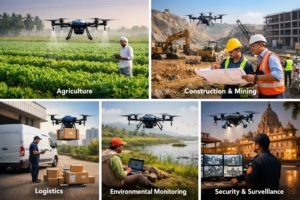
AI-powered drones are changing the mainstays of our society by adding the three features of speed, precision, and autonomy to them.
In agriculture, they make it possible to visually monitor crops, analyze soil, and even predict yields, thus raising productivity while at the same time saving the earth’s resources. The industries of construction
and mining are walking hand in hand with the advancement of technology, the latter benefiting the former not only from site surveys, progress tracking, and safety inspections but also from safety assurance as well as risk minimization.
By way of drones, logistics can now overcome the problem of slow delivery, inefficient inventory management, and a lack of operational effectiveness. Environmental monitoring is an instrument that uses drones to collect data on a large scale and monitor the changes in ecosystems, water quality, and wildlife habitats. At the same time, the security and surveillance sectors are also benefiting from AI drones equipped with patrol autonomy, threat detection, and quick response capabilities.
Set Up For Takeoff: What You Should Know Before Flying an AI Drone?
Before deploying an AI-powered drone, proper preparation ensures safe and efficient operations:
- Calibration: Adjust sensors, GPS, and IMU systems so the drone is able to fly accurately and detect obstacles properly.
- Environment Learning: Give the drone time to scan its surroundings; AI cannot operate without environmental data for autonomous navigation.
- Flight Modes: Choose the correct mode—manual, assisted, or fully autonomous, depending on the complexity of the mission and the need for safety.
- Safety Checks: Make sure that the propellers, battery condition, firmware updates, and communication links are all in good shape before every flight.
- AI Feature Guidelines: Be aware of AI-assisted features like obstacle avoidance, automated routing, and swarm coordination. Adhere to manufacturer and regulatory instructions to get the most out of performance and the least of risks.
The correct installation is the key to AI drones functioning without failure, giving accurate data while human intervention is kept at a minimum, and the operational safety is elevated.
A New Era of Autonomous Flight: What’s Coming Next?
The future of AI-powered drones is set to redefine autonomous operations. Key advancements include:
- Fully Autonomous Fleets: Drones will be able to function as a team without much intervention from humans; they will be able to execute complex tasks over vast regions.
- Predictive Decision Systems: AI will foresee changes in the environment, dangers during the mission, and maintenance requirements, thus enabling the system to take intelligent, preemptive actions.
- Multi-Mission Planning: Drones will be able to decide on the priority of the tasks and, at the same time, perform different activities such as surveillance, inspection, and data gathering in a single flight.
- Self-Charging Capabilities: The process of recharging will be uninterrupted, as automated docking and charging solutions will be available.
- Smart Routing & Optimization: AI will be able to find the best flight paths within the shortest time possible; thus, it will be able to deal with challenges such as obstacles, weather, and operational priorities, and at the same time, it will ensure maximum safety and precision.
These technological breakthroughs pave the way for the development of fully autonomous drones and, in fact, to intelligent aerial systems that are capable of operating independently, adapting to different situations, and being very efficient. Companies that will harness these capabilities will become remarkably agile in their operations, reduce their costs significantly, and gain invaluable insights from the data.
Why This Is the Moment for Businesses to Adopt AI-Driven Drones?
AI-powered drones are reshaping how businesses stay in competition, driving the demand for them in different sectors. The automation of complex tasks allows them to operate fast with few human interventions and to lower the risk of accidents in dangerous places significantly.
Advanced sensor-equipped units alongside AI-based analytical tools grant up-to-the-minute data, helping decision-making to be quicker and more accurate in the areas of inspection, monitoring, and surveying. Efficiency in operations is enhanced to a great extent as drones are able to execute the same tasks at large scales or for long periods of time, while the costs of manual labor, delays, and mistakes go down.
Any company from agriculture and construction through to logistics and security can achieve significant benefits by deploying AI drones, such as getting real-time data, raising productivity, and having operations that are safer, more trustworthy, and reliable.
The combination of autonomy, accuracy, and scalability in AI-driven drones not only makes them a technological upgrade but also a strategic imperative for businesses that are looking for agility and long-term value in a rapidly changing market.
The Sky Isn’t the Limit—It’s the Starting Line
AI-powered drones have transformed from remote-controlled devices into intelligent, autonomous systems capable of real-time decision-making. Equipped with advanced sensors, computer vision, and onboard AI, they navigate complex environments, execute precision tasks, and collaborate seamlessly in coordinated missions.
Industries from agriculture and construction to logistics and security are leveraging this aerial intelligence to gain faster insights, improve safety, and boost operational efficiency. As technology evolves, drones will redefine how businesses monitor, analyze, and interact with the world above.
Step into the next era of intelligent flight with Syrma SGS’s AI-powered drone solutions built for tomorrow’s challenges.
Disclaimer: Images used in this Blog are AI generated