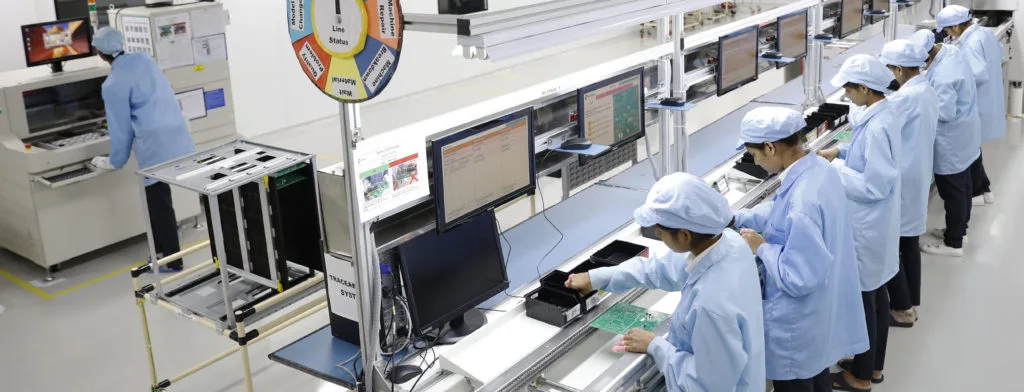
Not Long Ago: When India Was Mostly an Assembly Hub For years, India’s electronics industry functioned primarily as an assembly-driven ecosystem, focused on assembling products using imported components and external technologies. While this model helped establish a strong manufacturing base, the country remained largely dependent on global players for product design, semiconductor innovation, and advanced engineering capabilities. High-value activities such as embedded systems development, product architecture, and testing were often handled outside the country, limiting domestic participation in technology creation. ...
Every Tagged Item Has a Story Waiting to Be Read A shipment arriving exactly on schedule, a warehouse locating thousands of products within seconds, or a hospital instantly finding critical medical equipment. All these everyday operations rely on one powerful technology: RFID tags. As businesses increasingly prioritize automation, real-time visibility, and operational efficiency, RFID tags have become an essential tool for accurate identification and seamless asset tracking. Unlike traditional barcodes, they enable wireless data capture without direct line of sight, ...
Thermal Profiling: Solving Problems After They Appear In PCB assembly, thermal profiling is often overlooked until production issues begin affecting yield and reliability. Rising solder defects, inspection failures and increasing rework costs usually indicate that the reflow process is no longer under proper thermal control. While manufacturers focus heavily on stencil design, solder paste, and component placement during production setup, thermal profiling is often treated as a routine oven setting rather than a critical process parameter. In reality, every PCB ...
The Moment the World Began Rethinking Its Supply Chains For decades, global electronics manufacturing was concentrated in a few geographies driven by cost efficiency, mature supplier ecosystems, and scale. However, geopolitical tensions, trade disputes, pandemic disruptions, and logistics bottlenecks exposed the risks of overdependence on single hubs. This triggered a fundamental shift in global thinking from efficiency to resilience, diversification, and regionalized supply chains. Companies began actively seeking alternative manufacturing destinations capable of balancing scale with stability. Against this backdrop, ...
India's Electronics Manufacturing Services (EMS) sector is growing rapidly, driven by initiatives such as Make in India and the Production Linked Incentive (PLI) scheme. As the country strengthens its position as a global manufacturing hub, the However, choosing the right EMS partner is more than just comparing revenue. For example, a smartphone manufacturer, a medical device company and a defence OEM require different production, compliance and engineering capabilities. This guide analyses 12 leading EMS companies in the country based on ...
The Journey of a Wagon Begins with a Simple Scan Every freight wagon has a story to tell. A wagon loaded with raw materials may begin its journey at a mining facility, travel hundreds of kilometers through multiple rail networks, stop at marshalling yards, and finally reach a manufacturing plant. Throughout this journey, railway operators need accurate information about the wagon's location, status and movement. Traditionally, tracking wagons involved manual record-keeping, visual inspections, and paperwork, making the process time-consuming and ...
Meet the Silent Guardian Inside Your Dashboard: Airbag Controller Hidden behind the dashboard, the airbag controller acts as the central intelligence of a vehicle’s airbag system. As a specialized Electronic Control Unit (ECU), it continuously monitors signals from crash sensors positioned throughout the vehicle. These sensors detect sudden deceleration, impact forces, or structural changes during a collision. The controller processes this data in real time and determines whether airbag deployment is required. It is also connected to the vehicle’s electronic ...
When Locks Learned to Think: The Birth of Smart Access For centuries, locks were purely mechanical—reliable, but limited. The introduction of digital keypads marked the first shift toward electronic access, yet even these systems remained fundamentally static. Today’s smart locks represent a far more significant transformation: they are intelligent electronic systems capable of communication, decision-making, and integration within larger connected environments. A smart lock is no longer just a barrier; it is an access control node within a broader digital ...
Before the Breakthrough: When India Relied on Imported Electronics A decade ago, India was one of the world’s largest consumers of electronics but had limited domestic manufacturing capacity. High-value products such as smartphones, consumer electronics, and telecom equipment were largely imported, mainly from East Asian manufacturing hubs. This heavy reliance increased the country’s trade deficit and left critical supply chains outside India’s control, even as the digital economy expanded rapidly. Today, the situation has changed significantly. India is evolving from ...
When One Lost Shipment Sparked a Supply Chain Wake-Up Call What began as a routine shipment quickly turned into a serious supply chain concern. A pallet of temperature-sensitive oncology drugs left a pharmaceutical facility on schedule, logged and tracked through traditional barcode systems. Yet somewhere between the distribution center and the hospital pharmacy, the shipment vanished from the digital record. Soon, inventory teams could not trace their last checkpoint, emergency replacements had to be dispatched, and concerns about diversion or ...