
Smart Pen: Where Traditional Writing Meets Modern Thinking
For thousands of years, the pen has been a very personal tool, allowing people to express thoughts, make decisions, leave signatures, and tell stories. However, with the digitalization and data orientation of our world, the writing process has undergone an unexpected transformation. The smart pen emerges at this intersection, preserving the tactile comfort of handwriting while extending it into the digital realm. It represents not just a product evolution, but a thoughtful response to how modern professionals think, work, and record information.
Why Reinventing the Pen Makes Sense in a Data-Driven Era?
In the current, fast-moving, and data-driven world, the classic pen has started to reveal its shortcomings. Handwriting is still necessary for clarity, memory, and quick idea generation, but storing, sharing, and analyzing information have radically changed. The gap between the analog act of writing and the digital flow of data highlighted a critical gap: the pen needed a fundamental redesign.
Handwritten notes tend to be isolated, hidden in notebooks, practically impossible to search through, you can easily lose them, and it takes a lot of time to convert them into digital format. After a meeting, the conversation has to be manually transcribed; the drawings have to be photographed and labeled, and the written records have to be re-entered into digital systems, often causing errors and loss of context. Disconnected workflows switching from pen to keyboard to recorder and camera also cause loss of concentration and inefficiency, particularly in classrooms, boardrooms, hospitals, and worksites.
Smart pens address these challenges by transforming handwritten strokes into digital data in real time. They preserve the natural feel of writing while enabling seamless integration with apps, cloud systems, and enterprise workflows. Handwriting becomes actionable, searchable, and collaborative, aligning with modern productivity and data needs.
It is not just novelty that is driving the reinvention of the pen: it is relevance. The pen connects the human, tactile experience with smart digital functionality, thus writing remains personal as well as connected in a world that is ever more driven by data.
The Moment Ink Met Intelligence: How Smart Pens Actually Work
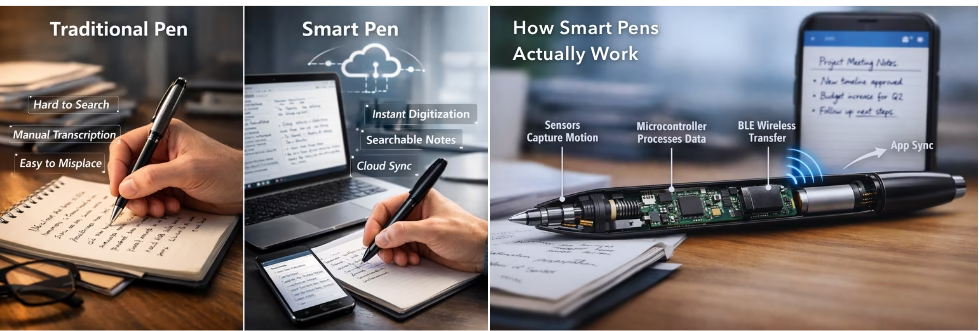
The smart pen’s intelligence becomes evident when ink is put on paper. What looks like a mere writing deed initiates a well-engineered process beneath the surface. While the pen glides, the built-in motion and pressure sensors record each stroke with high accuracy, noting the direction, speed, and force at once.
These raw inputs are processed instantly by a microcontroller inside the pen’s slim body. The hand movements are digitally mapped, maintaining the writer’s natural rhythm without any noticeable delay. The advanced firmware guarantees this change is done without the user noticing any time delay, and thus gives the same experience as with a regular pen on paper.
The resulting information can be saved internally or sent wirelessly via low-energy wireless protocols such as Bluetooth Low Energy (BLE) to connected devices, such as smartphones or tablets. Smart power management always keeps the system at a high level of efficiency by turning on different parts only when writing is performed.
Quietly and modestly, smart pens are the products of a mixture of mechanics, electronics, and software, which allow them to fulfill their function: converting the physical handwriting into structured digital information effortlessly, invisibly, and in real time without asking users to change how they write.
Inside the Frame: The Engineering Decisions That Shape a Smart Pen
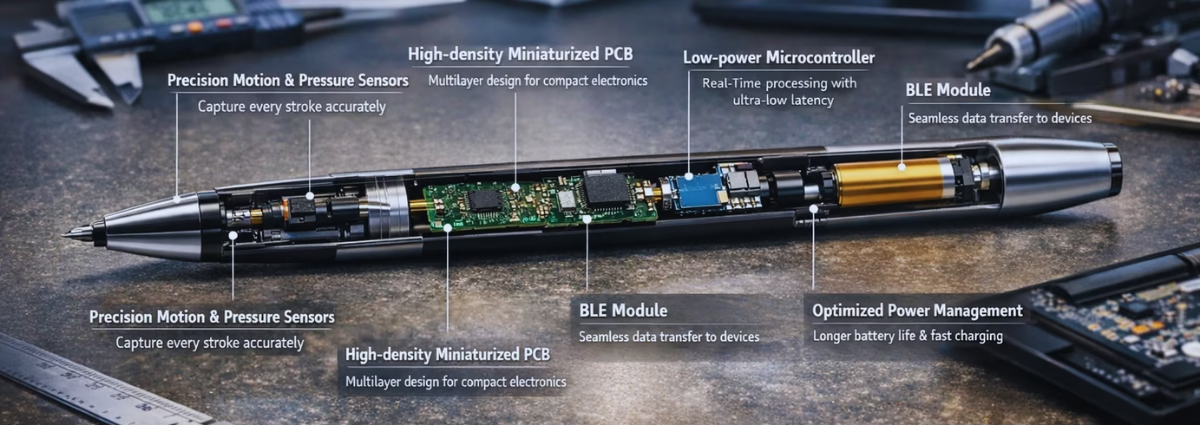
Behind the sleek exterior of a smart pen lies a series of deliberate engineering choices that transform a familiar writing instrument into a compact, high-performance electronic device.
- Precision Component Selection
Each smart pen starts by selecting the right combination of sensors, microcontrollers, and wireless modules that offer a great balance of accuracy, performance, and extremely low power consumption in a small-sized device.
- PCB Miniaturization Challenges
To fit a pen-sized enclosure, engineers develop high-density multilayer PCBs that not only keep the signals intact but are also thermally and mechanically durable even when they are subjected to such severe space constraints.
- Smart Power Management
Low battery capacity requires very clever energy-saving schemes, which may include sleep modes, very efficient voltage regulators, and quick charging circuits to keep the user experience uncompromised while still extending use time.
- Latency Reduction for Natural Writing
Ultra-low latency is critical to delivering a natural handwriting experience. By leveraging optimized firmware, real-time sensor processing, and efficient wireless communication protocols, data is captured and rendered instantly, ensuring digital writing feels smooth, responsive, and free from perceptible delay.
- Mechanical and Ergonomic Integration
The electronic parts need to share space with ink cartridges and other structural elements, while the pen still features a good balance, a comfortable grip, and the user is able to write in the usual way.
- Manufacturing and Scalability Considerations
DFM principles and practices are the guiding force for component placement, automated assembly, and calibration processes that guarantee high and consistent quality at scale.
- Reliability and Testing Standards
Smart pens are tested with different electrical, mechanical, and lifecycle testing processes to ensure consistent long-term performance even after being subjected to daily use for a long time.
All of these decisions in engineering make an ordinary writing instrument into an efficient, smart electronic gadget that is perfect for the contemporary digital world.
When Handwriting Turns into Data: The Real Value for Users
Smart pens make it possible to eliminate the everyday friction experienced when taking handwritten notes. Normally, ideas stay locked up in notebooks, but every stroke is immediately transformed into well-organized, searchable digital information. This avoids double work and reduces the risk of losing essential points.
Professionals can sync their meeting notes to their devices, share them with the team, and even listen again to the meeting while checking the notes, thus no detail goes missing. Students get a bigger boost in memory since their handwritten notes are digitized and can be easily reviewed and stored for the long term. In field jobs, smart pens help to gather data accurately even when keyboards or touchscreens can’t be used.
By combining the genuine act of writing with the benefit of added digital intelligence, smart pens have come up with a solution for a central issue on how to keep the neatness of handwriting without giving up the speed, accessibility, and dependability demanded by contemporary workflows.
How Smart Pens Fit Into Larger Digital Ecosystems?
Smart pens have evolved from being mere writing instruments to serving as smart input devices that are very much part of the digital ecosystem. Using wireless technologies such as Bluetooth Low Energy, smart pens can easily communicate with smartphones, tablets, and laptops, which leads to real-time synchronization of the handwritten data.
The companion apps that are specially designed for this purpose transform the notes into searchable digital versions, enable the association of the audio recording to the handwriting, and also facilitate sharing instantly across different platforms.
Besides integrating with personal devices, smart pens work very well with cloud-based applications and productivity tools. The handwritten content may be automatically saved, sorted, and backed up in note-taking apps, document management systems, or e-learning platforms, which makes your information readily available and safe.
At the workplace, smart pens connect to various software tools used for workflow, customer relationship management, and compliance, thereby converting handwritten data into formal documents that can be used for different business purposes.
As part of the growing IoT landscape, smart pens act as edge devices that capture data at the source. In field operations, healthcare, or manufacturing settings, they enable accurate data collection even in offline conditions, syncing with central systems once connectivity is restored.
By bridging physical writing and digital infrastructure, smart pens become a natural extension of modern workflows, enhancing productivity without disrupting how users think or write.
From Meeting Rooms to Worksites: How Smart Pens Are Changing the Way We Work
Smart pens are changing the way that professionals take, save, and make use of information. It is done in such a way as to ensure that the natural workflow is not disturbed. They combine the familiar act of handwriting with digital intelligence, thus allowing the creation of smarter, quicker, and more dependable documentation in different sectors.

- Corporate Meetings: Take handwritten notes that are audio-synced; thus, one can accurately remember what was said in the meeting and the decisions made without having to do manual follow-ups.
- Education & Training: Convert notes taken in the classes and training sessions into a digital format, thereby facilitating better memorizing, revising, and distance-learning processes.
- Healthcare Settings: Healthcare settings benefit by allowing doctors to write notes as they normally would, while the system securely converts them into well-organized, easily retrievable digital records.
- Field Services & Worksites: Allow the use of mobile smart pens in different environments, even in those with limited or no network connectivity and those that are harsh, so that the technicians can always update the documentation through photos, remarks, or measurements.
- Design & Engineering Teams: Transform sketches, annotations, and calculations into shareable digital files instantly.
- Compliance & Audits: Produce secure, time-stamped records to support regulatory and quality requirements.
Across environments, smart pens reduce friction between thinking and documentation—making work more efficient, accurate, and seamlessly connected.
Where Smart Pens Are Heading Next: Subtle Innovations Taking Shape
Smart pens are entering a phase of refinement, where subtle, user-focused enhancements play a decisive role in their success. Advances in sensor technology now enable greater stroke precision, capturing even the finest handwriting, sketches, and annotation details with remarkable accuracy.
On top of that, AI-powered handwriting recognition is able to offer more and more features like multilingual input, better context understanding, and easy conversion of the user’s notes into neat digital formats.
Battery life is getting better too: longer battery life and faster charging are features that allow users to work non-stop all day long. Besides that, smart pen integration with the larger digital world is becoming so tight that soon these little gadgets will have no problem talking to cloud platforms, collaboration tools, enterprise apps, or even IoT devices.
Consequently, the transition of your handwritten notes into the form of data ready for action will be that much easier. The physical appearance of smart pens also keeps changing, as they are getting lighter and more ergonomic, thus combining in a perfect way portability and durability.
Sustainability is emerging as a design priority, with recyclable materials and energy-efficient components. Collectively, these innovations are transforming smart pens from niche gadgets into indispensable tools that preserve the intimacy of handwriting while amplifying its digital potential.
A Thoughtful Pause: What Smart Pens Tell Us About the Future of Writing
Smart pens reveal a future where technology amplifies human expression rather than replacing it. They preserve the intimacy of handwriting while seamlessly translating it into actionable digital data, bridging tradition and innovation. For professionals, students, and creatives alike, this means effortless capture, organization, and collaboration without compromising the tactile joy of writing.
At Syrma SGS, we engineer intelligent solutions that transform everyday tools into powerful data-driven experiences, helping businesses and individuals embrace the next frontier of connected workflows.
Disclaimer: Images used in this Blog are AI generated


