
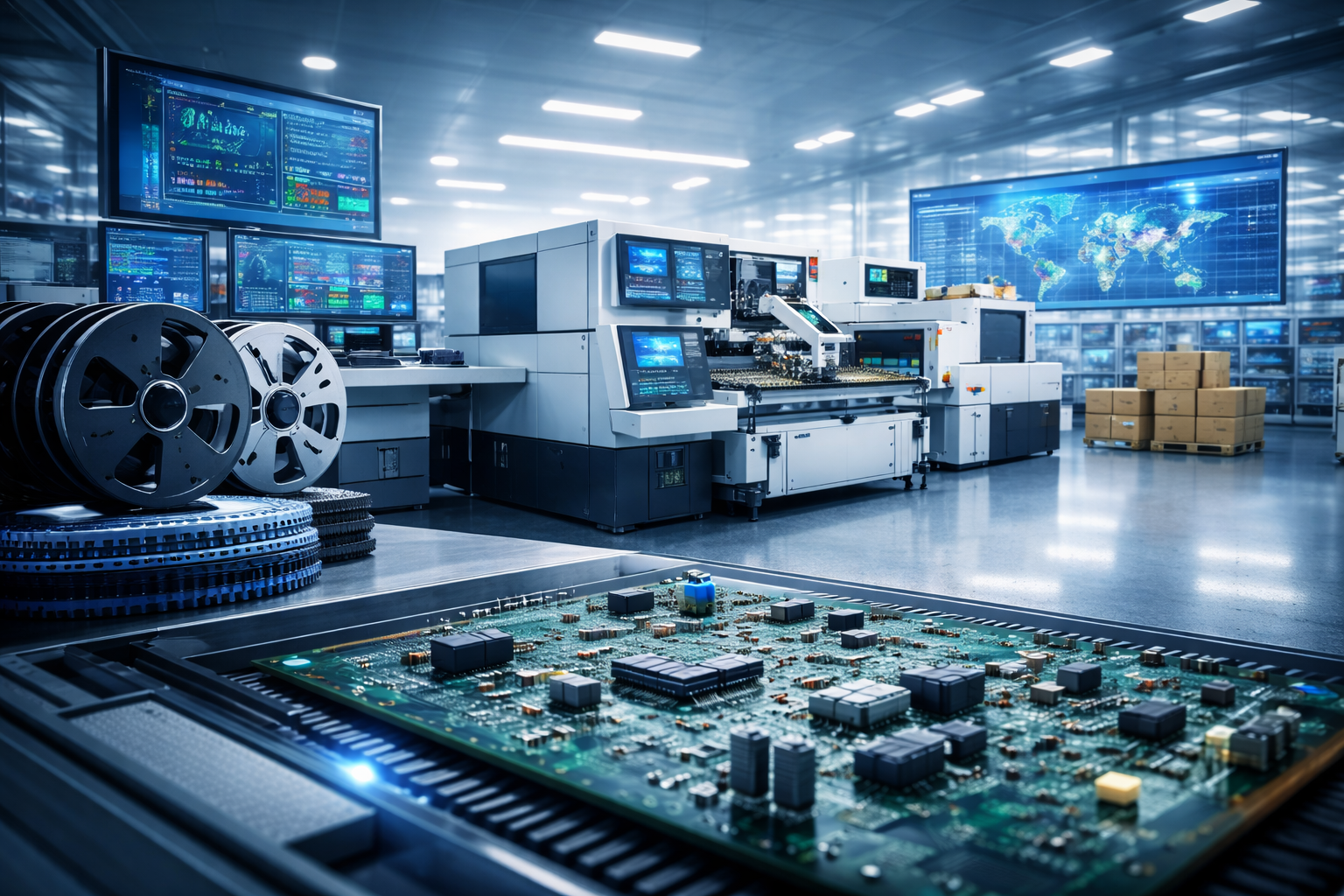
The cost pressure on Original Equipment Manufacturers (OEMs) in the electronics industry today is no longer just about pricing.
Rapid product obsolescence, unpredictable supply chains, and tighter regulations, on top of customers demanding ever-higher quality for less, all these factors combined mean that cost efficiency has to be designed into the product and process, not bargained for.
An experienced Electronics Manufacturing Services (EMS) provider can thus be a strategic partner to an OEM rather than merely a source of operational efficiency.
When OEM Challenges Stack Up: The Moment EMS Becomes the Missing Piece
Increasing offshore contribution is one of the key factors driving OEM complexity; the latter often outpaces the former. With the number of design iterations incessantly increasing, suppliers becoming increasingly difficult to predict, and production schedules closing in under mounting cost pressure, it is no wonder that the operations teams are often at a loss as to how to proceed.
Missed deadlines, inconsistent quality, and rising BOM costs don’t just strain operations—they create leadership stress and uncertainty around long-term viability.
Operationally, fragmented vendor management, limited manufacturing visibility, and constant last-minute problem reactions consume too much time and other resources. Teams frequently operate in a constant emergency mode, where each delay or defect poses a risk to customer trust and market standing.
At this stage, an experienced EMS partner becomes essential. Beyond adding manufacturing capacity, EMS brings structure, data, and deep manufacturing intelligence. By integrating engineering, sourcing, production, and quality into a single, coordinated system, EMS reduces uncertainty and gives OEMs greater control over outcomes, putting them firmly in the driver’s seat.
For OEMs, this marks a shift from reacting to issues to proactively controlling outcomes—turning manufacturing from a recurring challenge into a true competitive advantage.

How Intelligent Design for Manufacturability Cuts Costs Before Production Even Begins
Early collaboration between OEM engineering teams and an experienced EMS partner is essential. Intelligent Design for Manufacturability (DFM) is one of the most effective ways to reduce costs even before production begins. Bringing OEM engineers and a proficient EMS partner together at the earliest stage ensures potential cost escalators are identified and addressed during design rather than later, when changes become complex and expensive.
Some of the major cost-saving benefits resulting from early DFM are:
- Early risk identification: Manufacturing engineers raise the issue of complex arrangements, very fine tolerances, and high-risk components that could lead to poor yield or decreased reliability.
- Reduced redesign cycles: Through a series of pre-emptive design reviews, the number of late-stage engineering change orders (ECOs) and repetitive prototype iterations has been kept to a minimum.
- Optimized PCB layouts: Designs are optimized for automated assembly so that they are in line with it, resulting in an increase in placement accuracy and a decrease in manual intervention.
- Component and material optimization: Parts are selected based on considering factors like availability, lifecycle stability, and cost efficiency, giving rise to a decrease in procurement risks.
- Built-in testability: Design for Test (DFT) simplifies production inspection and accelerates fault isolation.
Original equipment manufacturers (OEMs) can reduce risk and cost by designing products that account for manufacturability, testability, and reliability from the outset.
On the other hand, by upgrading products to meet the customers’ expectations in terms of performance and precision, we may be able to avert unnecessary costs in the future, such as rework, scrap, and launch delays.
The Power of a Unified Supply Chain: How EMS Negotiates Better Pricing Without Cutting Corners
A unified supply chain is one of the most powerful cost levers of any EMS partner to OEMs that are willing to work together. An EMS partner can bring this cost lever to OEMs without compromising product quality, reliability, or compliance aspects of the products. This is very different from an ordinary procurement operation. EMS manages component sourcing across a broad portfolio. Instead, an EMS provider delivers complete manufacturing solutions, taking responsibility for sourcing, selecting, and integrating components as part of the finished product.
Because EMS providers aggregate demand across multiple customers and programs, they hold significantly stronger negotiation leverage than individual OEMs or smaller buyers. This scale enables access to better pricing, more reliable supply, and preferred component allocations. Beyond cost advantages, EMS providers can also secure higher-grade components, as premium-quality equipment often requires higher investment and long-term supplier relationships.
Beyond scale alone, established EMS providers cultivate long-term partnerships with supply partners built on consistency, transparency, and a shared commitment to performance and quality standards. These relationships unlock preferential pricing, priority allocation during supply constraints, and early access to emerging technologies and industry innovations, advantages that are often difficult for individual OEMs to secure independently.
Advanced forecasting and demand-planning tools can help bring cost control to the next level. By forecasting components more accurately, an EMS partner can keep the inventory level leaner, run the last-minute spot buys less frequently, and get fewer price hikes. Proactively, instead of reactively, new strategic sourcing decisions are ready to be implemented.
The outcome is a lower and more predictable Bill of Materials (BOM) cost, achieved through intelligence and coordination, not corner-cutting. For OEMs, this translates into sustained margins, reduced supply risk, and a more resilient manufacturing ecosystem.
Smarter Production Lines: Where Automation, Testing, and Precision Reduce Avoidable Spend
Modern electronics manufacturing goes beyond speed—it requires uncompromising precision, consistency, and control. Smarter production lines that are powered by automation and advanced testing help significantly in saving money by avoiding wastage.
Automated Optical Inspection (AOI) is capable of detecting at an early stage soldering defects, misalignments, and component issues, thus saving the rework from being very costly.
In-Circuit Testing (ICT) is an effective complement to quality by checking and confirming the electrical performance before the final assembly, hence lowering functional failures that occur at a later stage of the process.
Automated assembly significantly improves accuracy that can be repeated, thus eliminating errors and variability that come from manual operations, which can be caused by operator fatigue or lack of skills.
If real-time process monitoring is added to the mix, the manufacturer can see the changes in the yield, equipment performance, and process variations instantly. This enables the situation to be controlled at once, rather than after losses have piled up.
These manufacturing practices intelligently combined result in the reduction of scrap, rework, and unplanned downtime. Therefore, quality is embedded at every stage of production, hence reducing operational costs and increasing manufacturing efficiency at the same time.

Quality That Pays for Itself: How Reliable Builds Reduce Field Failures and Warranty Impact
Quality in electronics manufacturing should never be viewed as an expense, but as a strategic investment in long-term cost control. Quality assurance (QA) that is deeply ingrained in the production process can help manufacturers keep returns, warranty claims, and field failures at a minimum over a product’s lifetime. A good EMS partner will use rigorous process controls, statistical quality monitoring, and multi-stage inspections, which collectively contribute to a high standard and reliability at scale.
Beyond standard quality checks, reliability testing—including thermal cycling, vibration, and stress testing are performed to validate that products consistently deliver expected performance under real-world operating conditions before reaching end users. In parallel, adherence to global regulatory standards plays a critical role in minimizing the risk of recalls, penalties, or delays in time-to-market.
When OEMs discover defects in products only after they have been used by consumers, they have no choice but to shoulder the costs of costly service interventions, reverse logistics, and brand damage. As reliable builds continue to be produced, the total cost of ownership will significantly decrease, customers will be highly satisfied, and post-launch expenses will be predictable, thus confirming that quality, if properly set up, is a self-sustaining investment.
Logistics Without the Black Box: How Integrated EMS Supply Chains Shorten Lead Times
In electronics manufacturing, logistics inefficiencies often remain invisible until they impact delivery timelines and working capital. An experienced EMS partner removes this opacity by integrating logistics into the manufacturing ecosystem, enabling faster movement, lower costs, and greater predictability. Here’s how intelligent EMS-led logistics optimization delivers measurable value to OEMs:
- Consolidated Logistics Operations
EMS providers bring inbound components, sub-assemblies, and outbound finished goods all under the same logistics framework. This, in turn, is able to eliminate the fragmentation of the shipping process, reduce the number of handling points, and thus, keep transportation and administrative costs to a minimum.
- Just-in-Time (JIT) Inventory Models
By coordinating materials arrival with production schedules, EMS partners are able to completely avoid storing unnecessary inventory. A JIT strategy allows for holding fewer goods in warehouses, diminishing storage costs, and freeing capital that otherwise would have been tied up in slow-moving stock.
- Region-Specific Fulfillment Strategies
A network of localized manufacturing and fulfillment hubs allows OEMs to deliver products to the local markets at high speed. When a company is close enough to its customers, it can reduce the transit time, minimize customs delays, and cut down freight expenses while still offering high-quality service.
- End-to-End Visibility and Planning
Through system integration, we gain access to real-time information on the whereabouts of the materials and work-in-progress. Having such clear visibility makes it easier to anticipate the next steps, results in fewer rush orders and hence lower costs, and overall demand fulfillment sees an improvement as well.
- Lower Risk, Higher Agility
Making the supply chain simpler through logistics lessens the risk of supply disruptions and also quickens the responses to changes in demand – and this can be done without having to increase the overhead costs of operations. Integrated EMS logistics turn a traditional cost center into a strategic advantage, driving efficiency across the supply chain.
Scaling Production Without Scaling Cost: The Efficiency Advantage of a Mature EMS Partner
OEMs typically encounter hidden costs when they scale production, capital investments, workforce expansion, and process inefficiencies that chip away at their profit margins. A mature EMS partner, through smart manufacturing scale, can eliminate these obstacles for OEMs.
Advanced capacity planning ensures production ramps align with real demand, preventing overinvestment and underutilized resources. Multi-factory support adds resilience, allowing volumes to shift seamlessly across locations without disrupting timelines or quality. Flexible production lines enable quick changeovers, mixed-model manufacturing, and faster response to market fluctuations without additional setup costs.
Standardized processes, common infrastructure, and tried and tested ramp-up methodologies constitute the leveraging point of EMS partners in eliminating the typical scale-up bottlenecks in OEM growth to a great extent. As a result, expansion in volume is not only quicker but also accompanied by cost structures that are well under control, consistent quality, and minimal operational risk.
Real-World Cost Savings: What OEMs Actually Gain
The use of intelligent, EMS-driven manufacturing results in OEMs getting various cost benefits, some of which are quite surprising, and these benefits are tangible:
- Reduced NPI delays- By working together early with engineering and incorporating DFM, the development cycle can be shortened, thus reducing time-to-market costs.
- Lower prototype and redesign expenses- Fewer iterations lead to less engineering work and waste of materials.
- BOM costs optimized- The component prices are lowered through EMS scale, supplier relationships, and forecasting tools without any loss in quality.
- Production waste minimized- Scrap and rework are eliminated through automated assembly, AOI, ICT, and real-time monitoring.
- Warranty and service costs reduced- QA and reliability testing help to avoid field failures, and thus, less after-sales support is needed.
- Logistics and inventory streamlined- Handling, storage, and obsolescence costs are reduced by consolidating the supply chains and using JIT fulfillment.
- Scalable production without extra overhead- Production lines that are flexible and multi-factory support enable volume growth without corresponding cost increases.
By implementing all these measures, manufacturing is no longer a cost center but rather a profit enabler.

The Long Game: How OEMs Build More Resilient Products and Profitable Roadmaps with EMS
Manufacturing intelligence doesn’t reset with each product launch. EMS partners retain process knowledge, yield data, and reliability insights that inform future designs.
- Cumulative Manufacturing Intelligence: EMS partners hold on to the process knowledge, yield data, and reliability insights after multiple product generations. OEMs harness this intelligence to create improved, more cost-effective products.
- Reduction in Redesign Cycles: Identifying manufacturing issues in the early stages avoids repeating design iterations, thus saving engineering time and the waste of materials.
- Shorter lead-time to market: An efficient New Product Introduction (NPI) process coupled with harmonized EMS practices permits OEMs to bring new products to the market quickly without compromising quality or cost.
- Predictable cost Structures: Production driven by data, supplier partnerships, and quality knowledge makes costs become more stable over the course of multiple product cycles.
- Enhanced Reliability & Quality: Process controls that are built in and thorough tests help to reduce the cases of field failures, thus resulting in a decrease in warranty claims and lifecycle service costs.
- Production at Scale without Losing the Competitive Edge: The help of multi-factory and flexible assembly lines will enable OEMs to increase the output more efficiently without causing the cost to increase in the same ratio.
- Sustainable profits: Inefficiencies that are eradicated in one generation lead directly to improved margins. In this case, the roadmap can be used as the basis to continue with the next generations.
A Quiet Shift Toward Better Decisions
EMS is an intelligence layer that transforms how OEMs manage cost, quality, and efficiency. By integrating design for manufacturability, automated production, and unified supply chains, EMS reduces waste, prevents costly redesigns, and optimizes BOM spend.
Reliable QA and real-time monitoring ensure fewer field failures, while scalable production and streamlined logistics cut hidden operational costs. For OEMs, this means smarter decisions, faster time-to-market, and sustainable profitability.
Partner with Syrma SGS to leverage intelligent manufacturing solutions that quietly drive cost efficiency across every product lifecycle.
Disclaimer: Images used in this Blog are AI generated


