

When One Lost Shipment Sparked a Supply Chain Wake-Up Call
What began as a routine shipment quickly turned into a serious supply chain concern. A pallet of temperature-sensitive oncology drugs left a pharmaceutical facility on schedule, logged and tracked through traditional barcode systems.
Yet somewhere between the distribution center and the hospital pharmacy, the shipment vanished from the digital record. Soon, inventory teams could not trace their last checkpoint, emergency replacements had to be dispatched, and concerns about diversion or counterfeiting emerged. Regulatory documentation also became incomplete.
While the financial impact was considerable, the real risk was patient safety. Incidents like this highlight why pharmaceutical supply chains are rapidly turning to RFID for real-time visibility, traceability, and security.
Why Pharma Can No Longer Rely on Barcodes Alone
Barcodes have been the main component of tracking systems in pharmacies for many years. They are simple, cost-effective, and widely used in manufacturing and distribution networks. However, as pharmaceutical supply chains become more complex and global, the drawbacks of barcode-based systems become more apparent.
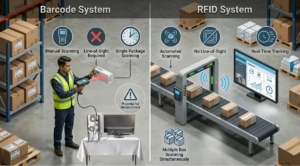
Barcodes require line-of-sight scanning, meaning each item must be individually scanned by an operator. In pharmaceutical settings with high volumes where there are thousands of serialized products per day, this method will slow down the operations and also increase the dependence on manual work. Errors made by people, skipped scans, or broken labels may also cause gaps in the tracking data, leading to risks regarding inventory accuracy and regulatory compliance.
Additionally, barcode systems provide only point-in-time visibility rather than continuous monitoring. Consequently, the product tracking in real time across warehouses, production lines, and distribution networks is very challenging.
While pharmaceutical activities increase, firms should use intelligent and automated tracking technology that provides quicker data capturing, more accuracy, and supply chain visibility in real time.
Beyond the Tag: How RFID Works in Real Pharma Operations
Radio Frequency Identification (RFID) has revolutionized the way we identify and track objects. Unlike barcodes that demand line-of-sight scanning, RFID can simultaneously collect information from numerous items without needing any manual operation. This makes it especially attractive in pharmaceutical settings where speed, precision, and the ability to trace products are of utmost importance.
The main elements of an RFID setup include RFID tags, RFID readers, and software systems at the backend. Tags are tiny gadgets that can be fixed on products, packaging, pallets, or containers. Each one consists of a microchip that holds a unique code and an antenna for communicating with different readers.
Readers are placed in such a way as to cover different areas like factory floors, main entrances to warehouses, and loading docks. Whenever the signal from a reader reaches tagged items, it immediately picks up the tag details even without a manual scan.
The gathered information is forwarded to backend enterprise systems like warehouse management systems (WMS) or enterprise resource planning (ERP) platforms. This software reacts instantly to the inputs by adjusting inventory lists, plotting the locations of products, and continuously updating digital traceability.
Together, RFID tags, readers, and integrated software create a seamless tracking ecosystem that improves visibility, reduces manual errors, and strengthens control across pharmaceutical manufacturing and distribution operations.
Inside the Pharma Floor: Where RFID Makes the Biggest Impact
RFID technology is gradually turning into a major factor enabling efficiency, traceability, and compliance in pharmaceutical manufacturing and distribution environments. The changes it brings are most obvious in the regular operations where live visibility and accuracy are must-haves.
- Raw Material Tracking: Using RFID tags on raw material containers allows one to automatically track materials from the time they are received till they are used for production. Hence, there will be fewer instances of materials being misplaced, better stock visibility, and guaranteed delivery of correct materials to production lines.
- Batch Monitoring: By using RFID, one can track pharmaceutical batches smoothly as they go through different production phases. Besides capturing time-saving data, automation helps in maintaining detailed batch records, which further enhances traceability and quality-control of manual errors.
- Inventory Accuracy: Since RFID readers allow multiple tagged items to be identified at the same time, warehouse staff can carry out counting of their stock in a faster and more precise manner that leads to a drastic decline in the time spent on reconciliation.
- Cold Chain Visibility: When RFID systems are merged with temperature sensors, they provide constant information about the environment for their drugs. Based on that, storage and transportation are regulated accordingly.
- Anti-Counterfeiting Protection: An RFID tag always has a unique digital identity that can be used for authentication in the entire supply chain, and this is one of the ways of keeping counterfeit drugs from being distributed through official channels.

Compliance Is Not Optional: How RFID Supports Regulations
Regulatory compliance is a critical requirement in pharmaceutical supply chains. Global frameworks such as the Drug Supply Chain Security Act (DSCSA) in the United States and the Falsified Medicines Directive (FMD) in the European Union mandate end-to-end drug traceability, serialization, and detailed transaction records to protect patients from counterfeit or diverted medicines.
RFID technology is a key enabler for pharmaceutical companies to comply with these stringent regulatory requirements. Compared to the manual methods of tracking products, RFID facilitates automatic product identification and real-time monitoring of the location of serialized products within the chain of manufacturing, warehousing, and distribution. A unique digital identity is contained in the tag of each product that can be scanned easily and instantly throughout the supply chain.
Thanks to this automation in data capturing, the quality and quantity of traceability records have improved significantly. Every movement of a product from the production line to the point of shipment will be recorded non-stop and automatically in the company’s systems, thus creating a sound digital audit trail.
Having real-time information about the location of the stocks would also minimize the compliance risks during regulatory inspections. Without relying on manual documentation, auditors can easily get access to verified records about the origin of the product, its handling history, and distribution pathways.
By enhancing traceability and minimizing human error, the use of RFID enables pharmaceutical companies to stay regulatory compliant, while keeping product integrity and patient safety the priorities.
From Cost Center to Competitive Edge: RFID’s True Value
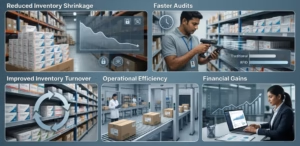
While RFID is often introduced to improve compliance and visibility, its operational benefits extend far beyond regulatory requirements. Organizations implementing RFID frequently see measurable improvements in several areas.
- Reduce Inventory Shrinkage
RFID technology allows pharmaceutical products to be continuously tracked in real time during manufacturing, warehousing, and distribution. This uninterrupted visibility is a great deterrent to misplaced stock, illegal diversion, and product theft, which are the main causes of shrinkage in the supply chain. Besides enhancing supply chain security, it also minimizes shrinkage drastically.
- Perform Audits More Efficiently and Correctly
Manual inventory audits, which involve scanning and documenting the items one by one, can take several days. RFID technology makes it possible to read the tags of many items at once within a couple of seconds, thus speeding up the inventory count process. At the same time, it creates accurate digital records that can also be used for regulatory and internal auditing purposes.
- Enhance Inventory Turnover
Access to real-time inventory data will enable pharmaceutical firms to efficiently control their stocks, thereby entirely eliminating overstocking. Also, an effective response to changes in demand will become possible. Consequently, the company will enjoy faster inventory turnover and less capital invested in surplus inventory.
- Optimize Operational Efficiency on a Large Scale
Eliminating manual scanning repeatedly through auto data capture can shorten warehouse workflow processes, reduce labor requirements, and, at the same time, increase accuracy in the process.
- Create Financial Impact You Can Measure
As a result of reducing losses, speeding up processes, and improving inventory management, RFID is able to convert supply chain efficiency into a measurable financial benefit. In fact, rather than a cost center, a supply chain can become a strategic business enabler.
From Circuit Board to Supply Chain: Role of Precision Manufacturing
Behind every dependable RFID system lies a base of top-notch electronics and precision manufacturing.
Various components like RFID readers, embedded controllers, and communication modules are built upon intricate electronic assemblies, which should be capable of performing well even in challenging environments such as factory floors, warehouses, and transport centers.
- RFID reliability begins at the hardware level. The performance of RFID systems depends heavily on the quality and precision of the electronic components that power readers, antennas, and embedded controllers.
- High-quality PCB assemblies ensure consistent signal processing. Well-engineered printed circuit boards allow RFID readers to capture tag data accurately, even in complex environments such as pharmaceutical warehouses and manufacturing floors.
- Embedded systems enable seamless device communication. Advanced firmware and embedded controllers allow RFID devices to process data quickly, filter signals, and communicate efficiently with enterprise systems.
- Precision manufacturing ensures long-term durability. RFID hardware must operate continuously in demanding conditions, including temperature variations, dust, and high operational loads. Robust manufacturing processes help maintain consistent performance over time.
- Rigorous quality testing reduces operational risks. Experienced Electronics Manufacturing Services (EMS) partners conduct extensive functional testing, calibration, and validation to ensure every device performs reliably before deployment.
- Scalable production supports large RFID deployments. As pharmaceutical companies expand their tracking infrastructure, EMS partners with strong manufacturing capabilities that can produce hardware at scale without compromising quality.
- Ultimately, reliable electronics form the backbone of effective RFID systems. Precision manufacturing ensures that every signal captured at the circuit level translates into accurate visibility across the pharmaceutical supply chain.
Where RFID Projects Usually Stumble and Why?
While RFID has the potential to significantly boost efficiency, a lot of projects run into trouble early on because technical and planning aspects get ignored. Identifying such hiccups is a major step toward smooth execution.
- Incorrect Tag Selection
RFID tags are not universally compatible with all environments. Pharmaceutical operations often involve liquids, foil packaging, and metal equipment that can interfere with signal performance. Selecting the wrong tag type can result in poor read accuracy and unreliable tracking.
- Signal Interference in Complex Environments
One can liken distortions in radio signals to the effect of throwing up metal racks, machinery, and cramped storage areas. Along the same line, liquid-filled containers regularly seen in the pharmaceutical production sector can cause absorption of RF, resulting in a reduction in detection range and system reliability if not appropriately engineered.
- Integration with Existing Systems
The RFID system should be able to work without any difficulty with warehouse management systems (WMS), enterprise resource planning (ERP), and compliance platforms. Otherwise, the information flow can be interrupted and hard to control.
- Underestimated Deployment Planning
RFID requires careful infrastructure planning, including reader placement, antenna configuration, and testing. Organizations that skip pilot testing or rush deployment often face costly adjustments later.
How to Successfully Implement RFID in Pharma?
For pharmaceutical operations, effectively implementing RFID systems must be well prepared and quite detailed in the planning stage. First, companies should start a pilot program in a controlled environment, such as a single zone of a warehouse or production line. This will be a validation of the tag’s performance, the reader’s accuracy, and overall system reliability under normal work conditions, especially in settings with products that are liquids, metals, or temperature-sensitive, that is, to ensure RFID works.
If the results are good, the next step is to prepare the infrastructure. This involves the thought-out placement of readers, the configuration of the antennas, as well as the existence of a reliable network, so that data may be caught at the key points, such as doors of loading/unloading areas, stores, and production lines.
The other part that influences the success of an RFID system is the choice of hardware. The proper selection of the RFID tags, readers, and embedded systems constitutes one of the main factors in achieving the best performance of the different packaging formats of pharmaceuticals, storage requirements, and handling situations.
Another very important step is to ensure that the new RFID systems are compatible with the existing ERP and warehouse management software. When this is done, the data flow will be seamless, and the benefits that come from the RFID technology, such as improving inventory management, traceability, and compliance reporting, can be leveraged.
Finally, companies should adopt a phased scaling strategy, gradually expanding deployment across facilities and distribution networks. This controlled rollout minimizes disruption while enabling organizations to refine processes and maximize the long-term operational value of RFID technology.
The Future: Smart Pharma with IoT-Enabled RFID
The pharmaceutical supply chain evolution is through the integration of RFID and Internet of Things (IoT) technologies. RFID is used for automated identification and tracking, and through the IoT, these tagged objects are connected to smart networks that regularly gather, send, and analyze operational data.
In smart pharma, RFID-based products, pallets, and containers interact with the IoT sensors and cloud platforms for providing live visibility in making, warehousing, and delivery processes. The temperature, location, and movement can be kept under the sensor all the time so that product integrity and regulations compliance are always guaranteed.
The most sophisticated level of analytics enables these features by making operational data usable and actionable. The forecasted model can spot disruptions, supply-and-demand optimizations, and interrupt detection, which corrects the anomaly effect.
With the integration of RFID, IoT, and analytics in real-time, pharma supply chains will be connected, transparent, and resilient, resulting in improvement of operational efficiency, the quality of product enhancing the safety of the patient.
Why the Right Electronics Partner Changes the Outcome
RFID success depends not only on the technology but on the strength of the electronics behind it. The right electronics manufacturing partner ensures scalable production, precision-built components, and systems designed to perform reliably in demanding pharmaceutical environments.
With expertise in embedded systems, quality compliance, and customization, an experienced partner helps organizations deploy RFID solutions that meet regulatory requirements while adapting to evolving operational needs. This foundation of reliable electronics is what transforms RFID from a pilot project into a long-term supply chain advantage.
Partner with Syrma SGS to build smarter, compliant, and future-ready RFID solutions for pharma operations.
Disclaimer: Images used in this Blog are AI generated


