
Reframing the Way We Look: How Smart Glasses Are Shaping Tomorrow’s Vision?
The concept of smart glasses extends beyond a mere technological innovation of the future, found in sci-fi or experimental labs. They represent a decisive shift in how humans interact with digital systems, bringing smart features directly into the user’s field of view. In a world where every business is becoming increasingly connected, data-driven, and technology-based, smart glasses are gaining recognition as a novel tool that seamlessly integrates the digital experience with the physical one.
At the intersection of wearable technology, IoT, and industrial intelligence, smart glasses are redefining productivity, safety, and situational awareness across sectors.
From Fiction to Frontline: The Real Reasons Smart Glasses Are Taking Off Today
Smart glasses have transitioned from science fiction concepts to practical frontline tools, driven by steady technological evolution and clear enterprise demand. Decades ago, wearable eyewear was a concept of popular culture that promised augmented vision and instant access to information. However, at first, real-world attempts were hampered by large and heavy hardware, short battery life, and unclear use cases; thus, the adoption was limited to experimental use and consumer curiosity.
With time, the advances in microelectronics, optics, and communication have transformed smart glasses into functional and durable industrial devices. Through innovations in lighter-weight materials, smaller sensors, and high-resolution micro-displays allowed comfortable usage throughout the day. Simultaneously, the emergence of IoT, cloud computing, and AI resulted in scenarios where live access to information became crucial, and thus, smart glasses found a real purpose and meaning.
Today, smart glasses are seeing increased enterprise adoption because they are capable of solving several operational challenges or real & practical challenges. They offer a hands-free mode through which workers can receive instructions, check live data, or get help from an expert without even interrupting the flow of their work. Nowadays, manufacturing, power systems, logistics, and field services sectors are using smart glasses for the benefits of work accuracy, fewer work stoppages, and workforce efficiency.
This shift from novelty to necessity marks a defining moment where smart glasses move decisively from fiction into the frontline of connected, intelligent operations.
What Fits Inside a Frame: The Miniature Engineering Behind Smart Glasses
Smart glasses are a remarkable example of how advanced engineering can be compressed into an ultra-compact, wearable form. Behind the slim frame lies a complex integration of electronics, optics, sensors, and connectivity, each optimized for performance, power efficiency, and comfort.
Main Tech Components of Smart Glasses
- Eye Tracking and Visualization: Micro-displays, waveguides, or prism-based optics facilitate visualizations of the AR environment directly in the users’ eyes without interrupting the view.
- Processing and Compute: Onboard CPUs execute instructions such as data analysis, AR rendering, and AI functionalities in real-time, frequently supported by edge computing to ensure minimal delay.
- Sensors and Cameras: Advanced cameras, depth sensors, inertial measurement units, and proximity sensors are some of the features that help in the tracking of motion, creating maps of surroundings, and gaining an understanding of the situation.
- Connectivity Modules: Built-in Wi-Fi, Bluetooth, and cellular capabilities ensure smooth communication with IoT devices, cloud-based systems, and corporate networks.
- Audio and Voice Interfaces: With the help of beamforming microphones and micro speakers, functionalities such as voice commands, hands-free telephony, and audio notifications, even in the loudest of places, are enabled.
- Power and Thermal Management: Compact batteries, power management integrated circuits with high energy efficiency, and thermal design together guarantee the wearable device to be user-friendly all day long.
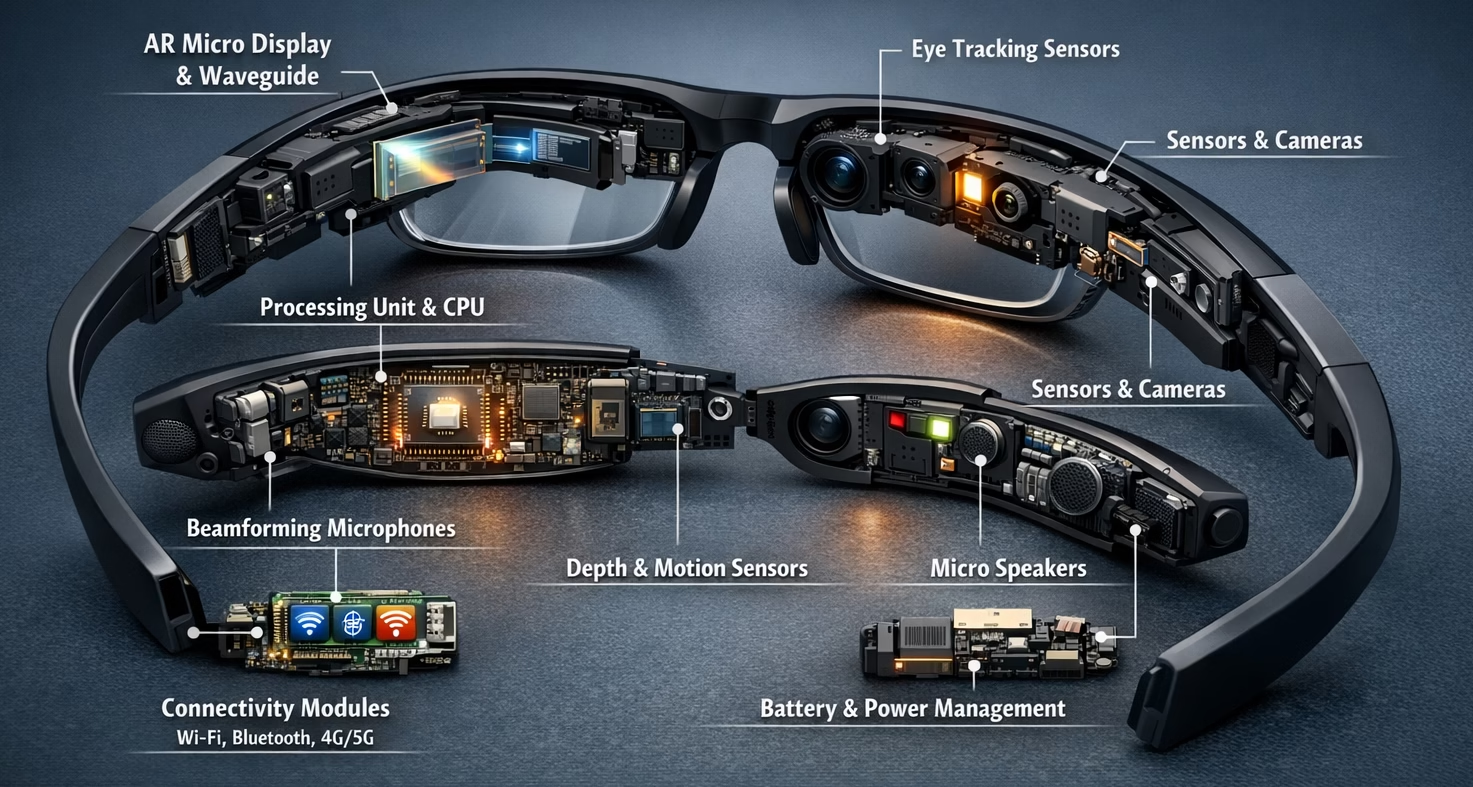
The real breakthrough is in the balancing of these components within a light, anatomically shaped frame, thus illustrating the power of detailed engineering in enabling smart glasses to provide intelligence without causing distraction.
Real-World Use Cases: Where Smart Glasses Are Already Delivering Value
Smart glasses are becoming more and more valuable in various industries. They allow workers to be hands-free while getting real-time information, which leads to higher accuracy and faster decision-making at the operational point. Their role has been very noticeable in environments where there is a lot of operational work.
Some of the main industry uses are:
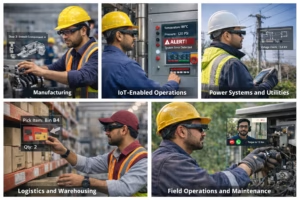
- Manufacturing
Smart glasses help the factory floor become less dependent on the human factor as they guide assembly, support quality visual inspections, and give real-time work instructions. Workers can always have their hands free and see the procedures as well, which results in fewer mistakes, reduced work, and less training time, as well as an increase in the overall effectiveness of production. - IoT-Enabled Operations
In a networked setting, smart glasses show live data from sensors, warnings, and the status of equipment. Hence, the engineer knows right away if the working of something is abnormal and can run diagnostics very quickly without having to look for other gadgets. - Power Systems and Utilities
On-site workers can obtain the right drawings, safety protocols, and asset information without having to use their hands, as these items are directly in their line of sight. Remote expert guidance helps to bring response times down, besides ensuring that safety measures are followed. - Logistics and Warehousing
Pick-by-vision method leads workers through the least wasting routes, thus increasing picking accuracy and speed of order fulfillment, and at the same time lessening fatigue. - Field Operations and Maintenance
With smart glasses, remote assistance, digital record keeping, and field fixing becoming possible, which results in less downtime and reduces the number of times a technician has to return to a site.
Individually and collectively, these examples show how smart glasses are a bridge between digital intelligence and the real world, which leads to increased productivity and operational gains achieved.
Where Design Meets Intelligence: How Smart Glasses Balance Style and Tech
Technological sophistication alone cannot guarantee the success of smart glasses. It is also about how intuitively they fit into our daily activities. A key consideration for smart glasses is comfort and fit to enable users to wear them for longer without discomfort.
This means the frames should be light, the weight needs to be distributed evenly, and the users should have the option of adjusting the fittings that help them wear it for a long time without getting tired.
Battery life is just as important and should be capable of supporting full working shifts while still being in a small size, a challenge that is constantly being addressed by adding energy-saving processors and fine-tuning power management.
Besides that, the looks can also be a factor that decides the fate of smart glasses. Present-day smart glasses are made in such a way that they appear simple and barely noticeable, and are a perfect combination of modern design and industrial strength.
Hidden beneath the elegant exterior are the highly complex circuitry, lenses, and sensors that are very cleverly arranged to provide intelligence without feature overload.
Through the adoption of human-centered design, smart glasses can find the perfect balance between beauty and practical use. First of all, technology helps to improve the user’s experience. The value of the devices increases significantly when harmony is achieved between the elements and the technology.
More Than Tasks: How Smart Glasses Are Effortlessly Improving Daily Workflows
Rather than radically changing how work is done, smart glasses subtly enhance existing workflows.
- Enables hands-free access to real-time information, allowing workers to stay focused on critical tasks without switching devices.
- Deliver context-aware instructions and visual guidance, reducing errors and rework across complex operations.
- Streamline training and onboarding through step-by-step AR overlays, shortening learning curves for new employees.
- Support remote expert assistance, enabling instant collaboration and faster issue resolution in the field.
- Improve decision-making by displaying live IoT data, alerts, and system status directly in the user’s line of sight.
- Enhance workplace safety with real-time warnings, compliance checks, and hazard identification.
- Increase operational efficiency by minimizing task interruptions and manual documentation.
- Integrate seamlessly with enterprise systems, ensuring consistent data capture and traceability.
- Adapt across industries from manufacturing and logistics to power systems and field services without disrupting existing workflows.
- Quietly transform daily operations by making productivity gains feel natural, intuitive, and continuous.
Silently change the routine by letting the increase in productivity come across as natural, something that the employees can do instinctively here and now, and continuous.
The Future in Your Field of View: What’s Coming Next for Smart Glasses
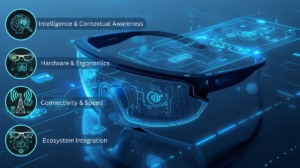
The upcoming smart glasses will focus on sharper intelligence, faster connectivity, and being deeply integrated with connected ecosystems. With the help of artificial intelligence, users will be able to see real-time object recognition, receive predictive guidance, and have decision support that is aware of the context right within their field of view.
5G and edge computing deployment will open up a whole new level of ultra-low latency, which will make remote collaboration and live data streaming not only faster but also more dependable. The use of improved waveguide optics, energy-efficient processors, and advanced battery technologies will make the visual experience clearer, and at the same time, users will be able to wear these gadgets throughout the day without any discomfort.
Smart glasses development will lead to such devices being able to connect more and more with IoT platforms and digital twins. This way, they will no longer be just wearable displays but intelligent, mission-critical interfaces for future-ready industries.
Why the Smart Glasses Era Is Only Just Beginning?
Smart glasses are transforming the way work connects with intelligence. As IoT ecosystems grow and operations become more data-driven, these wearables are emerging as a natural interface between people, machines, and connected environments.
By delivering real-time insights, guided actions, and seamless collaboration, smart glasses enable faster decisions and safer, more efficient workflows across industries. This is a redefinition of how technology supports human capability.
With Syrma SGS, turn this vision into reality by engineering smart glass solutions that integrate seamlessly into connected, future-ready operations.
Disclaimer: Images used in this Blog are AI generated


