
When a Circuit Board Needs to Become a Complete Product
Electronic manufacturing extends beyond assembling components onto a printed circuit board (PCB). While printed circuit board assembly (PCBA) establishes the circuit’s electrical functionality, a complete product may also require enclosures, cables, wire harnesses, connectors and power supplies. Integrating these elements creates a functional electronic unit.
Understanding the difference between PCBA and box build helps original equipment manufacturers (OEMs) define manufacturing requirements and allocate responsibilities effectively.
While PCBA focuses on board-level assembly, box build involves product integration and system-level testing. The right choice depends on product complexity, in-house capabilities, testing requirements and the intended deliverable.
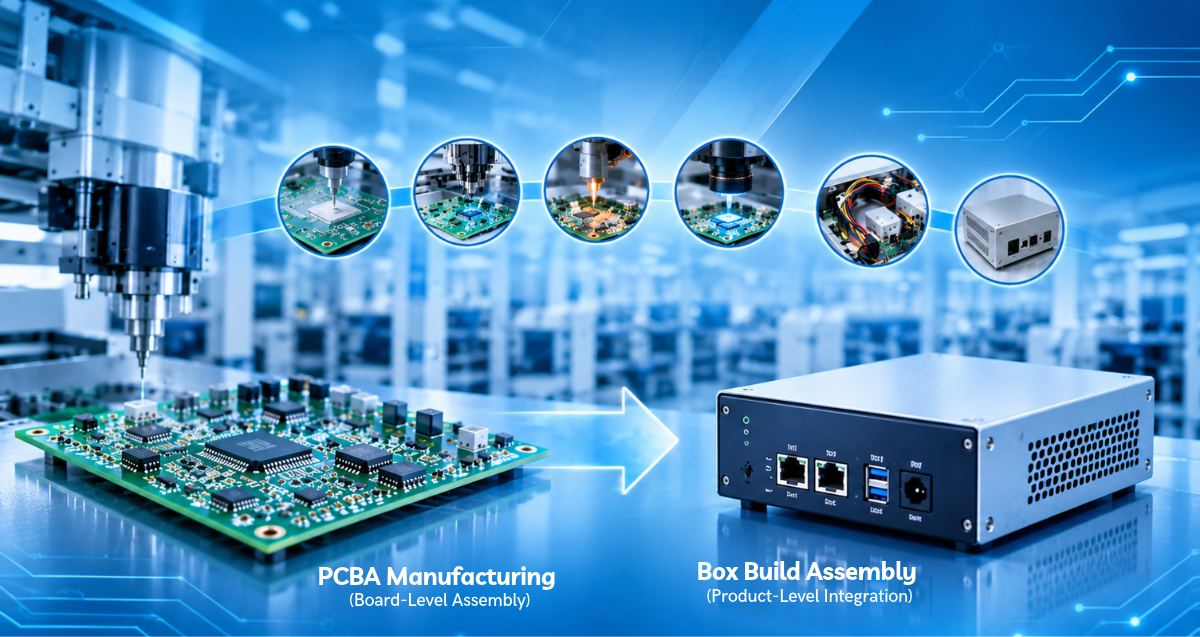
PCBA vs Box Build: The Difference at a Glance
PCBA focuses on assembling electronic components onto a printed circuit board, while box build integrates the assembled board with mechanical and electrical components to create a functional product.
Understanding the difference helps OEMs define manufacturing scope, testing requirements and final deliverables based on product complexity.
| Comparison Factor | PCBA Manufacturing | Box Build Assembly |
| Primary purpose | Assembles electronic components onto a printed circuit board (PCB). | Integrates PCBAs with mechanical and electrical components to create a functional subassembly or complete product. |
| Manufacturing activities | Solder paste application, component placement, soldering, inspection and board assembly. | PCBA installation, enclosure assembly, wiring, cable integration and mechanical and electrical integration. |
| Components involved | Bare PCBs, integrated circuits, resistors, capacitors and electronic connectors. | PCBAs, enclosures, cables, wire harnesses, power supplies, switches, cooling fans and mounting hardware. |
| Testing requirements | Automated optical inspection (AOI), X-ray inspection where required, in-circuit testing and board-level functional testing. | Continuity checks, interconnection verification, system-level functional testing and end-of-line testing, as specified. |
| Final deliverable | An assembled circuit board that meets the agreed manufacturing and testing requirements. | An integrated electronic subassembly or finished product, depending on the agreed manufacturing scope. |
| Typical applications | Control boards, power supply boards, communication modules and embedded electronic circuits. | Industrial controllers, power electronics units, communication equipment and electronic devices. |
| Best suited for | OEMs with in-house capabilities for enclosure assembly, wiring and final product integration. | OEMs seeking a broader manufacturing solution that integrates electronic, mechanical and electrical components. |
| Key advantage | Enables focused, precise circuit-board assembly and board-level quality control. | Consolidates multiple assembly stages and supports streamlined product integration. |
PCBA focuses on circuit-board assembly, while box build extends manufacturing to product-level integration.
The appropriate option depends on product complexity, internal manufacturing capabilities, testing requirements and the final deliverable expected from the EMS provider.
What Does PCBA Manufacturing Include?
PCBA manufacturing involves attaching and soldering electronic parts to a blank PCB to produce a working circuit board.
Accurate component placement, soldering control, and defect identification through quality checks ensure your final product meets the drawings and performance requirements.
Below are the major phases in PCBA manufacturing:

- Solder paste printing: The method here is to place the solder paste (a mixture of solder and flux) onto specific pads of the PCB via a printed stencil. Precisely applied solder paste forms solid electrical and mechanical bonds during the soldering process.
- Component placement: In this step, a fully automatic pick-and-place machine places surface-mount components like resistors, capacitors, or integrated circuits on the PC board design, also in accordance with the bill of materials (BOM). On the other hand, through-hole components can be mounted separately if there is a need.
- Soldering: The soldering of a surface-mount component is done mostly via reflow soldering. Through-hole components, on the other hand, can be soldered using wave, selective, or hand soldering, depending on the design of the board and the specifications of the component.
- Inspection and Quality Control: A combination of inspection techniques such as automated optical inspection (AOI), X-ray inspection and others serve as a means to detect component misalignment, soldering defects besides hidden joint issues if there are any.
- Board-level test: According to the product specifications, after assembly, the boards may be subjected to in-circuit (ICT) or functional test to verify electrical connections and operational functionality.
The manufacturing procedure is not only affected by the complexity and component types but also by application requirements.
A properly controlled PCBA procedure will enable consistent assembly, product reliability and overall manufacturing quality before the board is integrated into a system or delivered as a separate assembly.
What Does Box Build Assembly Include?
Box build assembly is basically putting together a piece of electronics by connecting together PCBs with other mechanical, electrical and electromechanical components.
The process consists of several major parts such as:
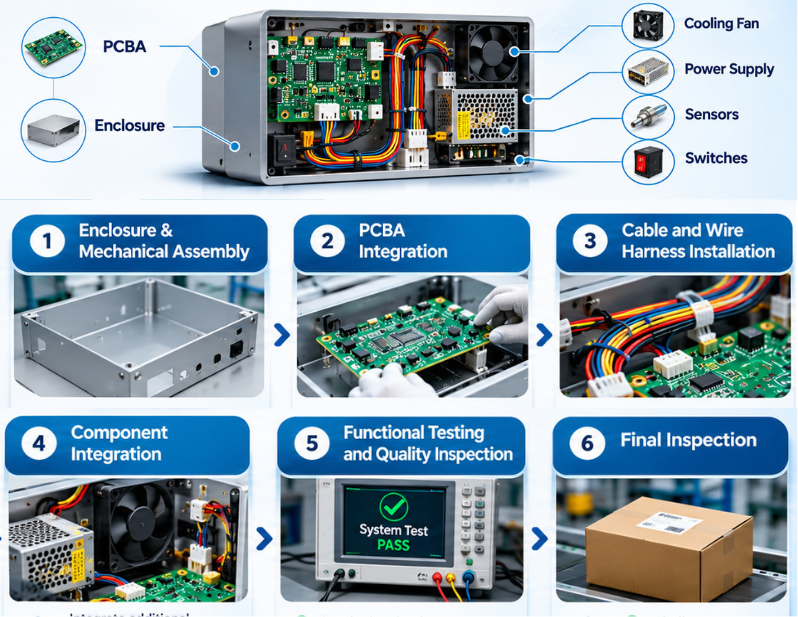
- Enclosure & Mechanical Assembly
The main function of the enclosure is to house all other components and to protect them while simultaneously providing structure to the whole package. It is also crucial that components are placed properly so that they do not come into unintended contact or interference. Assembly of the enclosure and parts such as brackets and hardware is what gives you the structure.
- PCBA Integration
PCBs that have been built are then placed into the enclosure using mounting arrangements specified for the component. Also, the clearance, electrical isolation and heat aspects are taken care of properly.
- Cable and Wire Harness Installation
Installation of cable, wiring harness and connectors is the means of achieving all required electrical communications (i.e., signal and power delivery) through PCBs – power supply units, sensors, displays, interfaces external (e.g., USB port).
- Component Integration
Depending on the requirements of the product, other necessary parts, such as cooling fans, sensors, switches, power supply units and communication modules, were fitted to the device.
- Functional Testing and Quality Inspection
Upon completion of the assembly and packaging, the product is subjected to various quality control tests, such as insulation test, continuity check and functional test, so as to guarantee system performance and correct interfacing.
- Final Inspection
Labeling, configuration checking, documentation and packing are fully completed under the requirements of the agreed-upon manufacturing process.
Where Does PCBA End and Box Build Begin?
The line between PCBA work and box build depends on a manufacturing agreement between the OEM and its electronics manufacturing services (EMS) provider.
- PCBA – Board-Level Assembly
One of the major processes of PCBA is the installation of electronic components onto a raw printed circuit board, followed by soldering. The main phases include placing components, soldering, inspecting, as well as specific testing at the board level to identify any errors in the assembly, confirming the electrical properties, and overall quality of the product.
- Box Build – Product Integration
The box build not only refers to the board but also includes different types of mechanical components such as enclosures, cables, wire harnesses, etc. It also involves other parts like connectors, power units, cooling devices and any other electrical or mechanical parts that go with the board to make up the final product.
- Wiring and Enclosures
Based on the contract, tasks such as supplier qualification for enclosures, fabrication of cable assemblies, installation of wire harnesses and connection of subsystems may be handled either by the vendor or the supplier.
- Testing and Validation
Usually, PCBA testing is restricted to the level of the individual board; however, in box build, more thorough functional system testing may be carried out to ensure the interoperability and performance of all the components.
- Final Assembly and Delivery
Depending on the agreement, box build may also include loading of firmware, conducting final inspections, labelling, and packaging.
- Defining the Scope of Manufacturing
Assigning clear responsibilities for component sourcing, assembly, testing, and documentation will help eliminate operational gaps and ensure the final product meets stated quality and functionality requirements.
PCBA vs Box Build: Which Option Should You Choose?
Deciding between PCBA and box build hinges largely on a company’s product requirements, available in-house manufacturing resources and how it plans to integrate the finished components.
PCBA should be considered if you require only assembled circuit boards and are able to handle enclosure installation, wiring and final integration internally. This option allows great flexibility and enables you to test each printed circuit board individually before making it a part of the whole unit.
Box build is recommended in cases where you are going to have integrated electronic assemblies or finished products. When you box build, you put PCBAs together with your enclosures, cables, wire harnesses and other parts; thus, you eliminate not only the supplier coordination but also your assembly work.
A combination of these two options is probably the best solution to optimize your manufacturing process and link together board assembly and system integration. By working with a single EMS provider that offers both types of services, you can greatly coordinate and control your production process.
Prior to making the final decision, it is recommended that you carry out an analysis in terms of testing, the quantities you produce, the manufacturing costs as a whole and what the customers would eventually receive.
Does Box Build Cost More Than PCBA?
Here is an indicative cost breakdown for India, based on published 2026 pricing guides and supplier listings. Actual prices depend on the design, order quantity and scope of supply.
| Cost component | Indicative cost (₹) | Pricing basis |
| Simple PCBA assembly | ₹70–₹220 | Per board, 1,000–10,000 units |
| Complex PCBA assembly | ₹180–₹650 | Per board, 1,000–10,000 units |
| Plastic enclosure | From ₹250 | Per unit, standard enclosure listing |
| Sheet-metal enclosure | From ₹1,000 | Per unit, supplier listing |
| Box build assembly add-on | ₹150–₹600 | Per unit, simple enclosure, volume production |
| Functional testing | Quotation required | Depends on test coverage and equipment |
| Wiring and cable integration | Quotation required | Depends on cable count, length, and connector type |
| Labour and final integration | Quotation required | Depends on assembly time and complexity |
These are indicative planning figures, not verified quotations from Syrma SGS. The PCBA assembly price may exclude the bare PCB and electronic components, while the box-build add-on may exclude the PCBA itself.
What Should You Ask an EMS Provider Before Choosing?
Selecting an EMS provider requires evaluating its technical capabilities, quality systems, supply-chain management and ability to meet production requirements. Before making a decision, consider the following questions:
- Manufacturing Capabilities: Can the provider support your PCB complexity, component technologies, box build assembly, cable integration and product-specific requirements? Does it offer prototyping and scalable production?
- Component Sourcing: Can it procure electronic components, enclosures, connectors, and other materials against an approved bill of materials (BOM)? How does it manage shortages, obsolescence and component traceability?
- Testing and Validation: Does it provide automated inspection, electrical testing and functional testing at board and system levels? Can it develop customised test procedures for your product?
- Quality Controls: What inspection protocols, process controls, certifications and corrective-action procedures support consistent manufacturing quality?
- Production Capacity: Can its facilities accommodate your production volumes, ramp-up requirements, lead times and future demand without compromising quality?
- Final Deliverables and Responsibilities: Who manages enclosure assembly, wiring, firmware loading, final testing, documentation and packaging? Are these responsibilities clearly defined in the manufacturing agreement?
Evaluating these factors helps OEMs compare providers beyond unit pricing. A clearly documented scope, measurable acceptance criteria and transparent accountability can reduce integration risks and support reliable, scalable production.
PCBA and Box Build Services at Syrma SGS
Syrma SGS offers electronic manufacturing capabilities spanning PCBA, box build and product-level integration to support diverse OEM requirements.
Its PCBA capabilities address the precise assembly of electronic components, while box build services extend to integrating circuit boards with enclosures, cables, wire harnesses and other components to create functional assemblies.
Supported by engineering expertise, testing capabilities and manufacturing infrastructure, Syrma SGS helps businesses align production processes with product complexity, quality requirements and volume needs.
Whether you require standalone board assembly or a more comprehensive manufacturing solution, the scope can be tailored to your product specifications.
Explore Syrma SGS’s electronic manufacturing services and engineering and system integration capabilities. Partner with Syrma SGS to translate your electronic designs into reliable, manufacturable products.
References for Cost
- https://www.formesmart.com/blogs/electronics-manufacturing-services-india-process-cost.html
- https://www.tradeindia.com/manufacturers/plastic-electrical-enclosure.html
- https://www.tradeindia.com/manufacturers/sheet-metal-enclosures.html